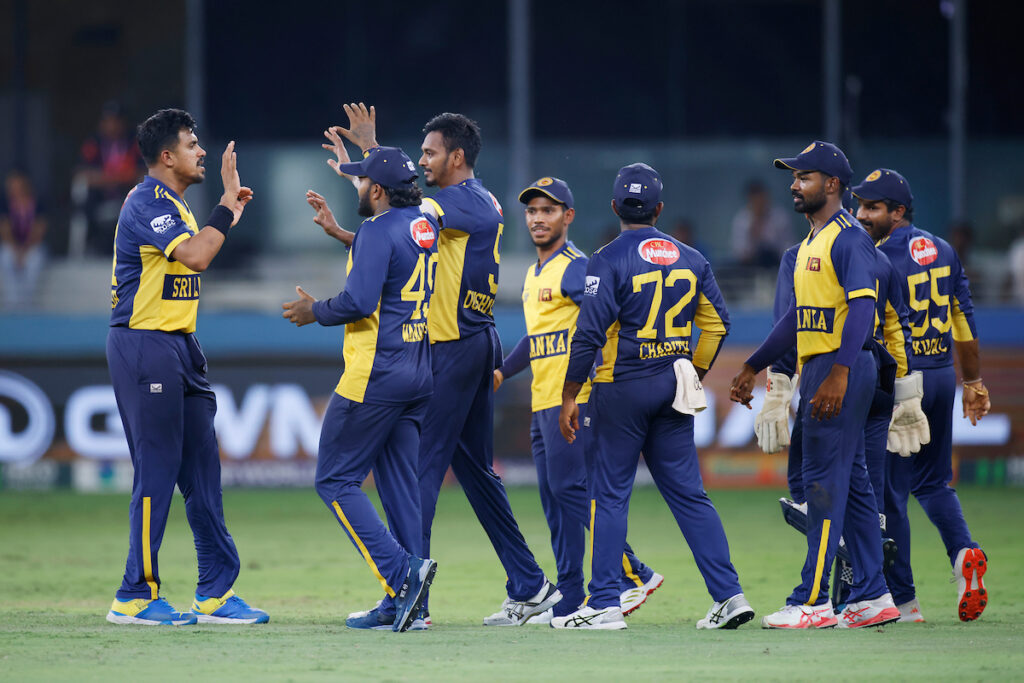
Sri Lanka players celebrates the wicket of Hardik Pandya of India during the Super Four match of the DP World Asia Cup 2025 between India and Sri Lanka at the Dubai International Stadium, Dubai, United Arab Emirates, on 26 September 2025. Photo by Vipin Pawar / CREIMAS for Asian Cricket Council
Shan Masood’s stoic hundred: technique, temperament and leadership
Domestically, Afridi has been a workhorse, amassing more than 350 first‑class wickets at an average in the mid‑20s. Those numbers, achieved on largely untelevised pitches, underscore the scale of his perseverance and hint that his Test selection was merited on performance rather than romance.
Pakistan captain Shan Masood produced one of the finest knocks of his career on the opening day of the Rawalpindi Test. Coming to the crease after Abdullah Shafique was bowled by a turning delivery from Simon Harmer, Masood faced a pitch offering turn and variable bounce from the outset. Rather than retreat into a shell, he trusted his technique. He played late and close to his body, smothering spin and punishing anything over‑pitched. His footwork was exemplary: he used his long reach to negate full balls and rocked back to cut when the bowlers dropped short. A crucial element of his innings was strike rotation; he nudged singles into the covers and midwicket, ensuring bowlers could not settle. By the time he raised his bat for a fifty, he had faced 115 deliveries but looked unflustered.
Masood’s partnership with Abdullah Shafique was foundational. The pair added 111 runs, the bulk of Pakistan’s total on a day where run‑scoring was hard work. They complemented each other: Shafique’s compact defence and willingness to leave outside off stump paired well with Masood’s cover drives and flicks. Both benefitted from dropped catches – Tristan Stubbs grassed Masood at 40 and Tony de Zorzi put down Shafique – but such lapses did not diminish the skill required to bat for long periods. After Shafique fell to Harmer, Masood shepherded the middle order, sharing stands with Babar Azam and Saud Shakeel. He eventually perished for 87, bowled by Keshav Maharaj after being beaten in flight.
Beyond the runs, Masood’s innings was a study in leadership. Pakistan had lost the toss in Lahore and been criticised for their decision making on a spinning pitch. In Rawalpindi, Masood showed that patient batting was possible if one applied the right method. His calm demeanour diffused panic in the dressing room. Between overs, he was seen encouraging younger batters and discussing field placements with his bowlers. Off the field, he has been a vocal advocate for mental health awareness and team unity. He emphasises process over result, a mindset that is beginning to permeate the side. Former captain Misbah‑ul‑Haq, now a commentator, praised Masood’s maturity and noted that Pakistan had not seen such composed leadership since the days of Misbah and Younis Khan.
The significance of Masood’s innings extends beyond the immediate match. Pakistan have often struggled to find consistent openers and leaders in Test cricket. Masood’s ability to combine the two roles is invaluable. If he continues to score runs and marshal his troops effectively, he could become the long‑term face of Pakistan’s red‑ball team. His technique, built on playing domestic cricket in England and Pakistan, equips him to handle varied conditions. For young batters watching, his innings is a template: play straight, trust your defence and seize scoring opportunities without undue risk.